WHY WE CHOOSE THIS TOPIC ?


The aim of this blog is to remove whatever doubts that may have entered some people’s minds regarding denial of any violence against Hazrat Fatima Zahra (s.a.) at her home, or against Hazrat Ali (a.s.) at the house of Janabe Fatima Zahra(s.a.).
Authentic references have been provided in the fond hope of a definitive conclusion and the eradication of all doubts Inshallah.


Search This Blog

Sunday, August 24, 2025

ATTACK ON THE HOUSE OF JANABE ZAHRA (SA). - VIEWS OF SHIA SCHOLARS


Introduction

The Shi’a scholars have all spoken on this incident, and the Ijma’ of Shi’a on a matter reveals that it is from the Ahlul Bayt, just as in the case of reciting BIsmallah loudly or Hayy ‘Ala Khayr al ‘Amal in the call to prayer. Even if one doesn’t grant that the ijma of the Shia scholars is enough to prove that Ahlul Bayt (AS) believed in Fatimiyya, what this ijma would at the very least prove is that the belief in Fatimiyya is early


The words of Imami Scholars themselves:

1. al-Sayyid al-Himyari (d.173H)

al-Sayyid al-Himyari has a poem in which he states:


"She was beaten and her right was usurped. And then they let her taste the pain of injuries and wounds.

May that hand be cut who hit her And the hand of those who are content with that and follow him.

May Allah not forgive him and or make him safe of the fear of the Day of Resurrection" 

Siraat Al Mustaqeem V3 Page 13

2. al-Barqi (d.245 H)

al-Barqi within the same page is narrated to say

"They collected firewood to burn the house And lit it

even though there were children in it

And in the house there was not except the purified ones

Of women and the truthful one and the grandsons (of the Prophet (saw))

I do not say that they did treachery, they rather disbelieved And disbelief is

less than burning the children (of the Prophet (saw))

And whatever of their tyranny and wrongdoing they did Will be two chains around their necks in Hellfire"

Siraat Al Mustaqeem V3 Page 13

3. Muhammad b. Abi Zaynab al-Nu’mani (d.360H)

“They did wrong to Fatima, the infallible Prophet’s daughter, to a degree that she (as) recommended in her will to be buried secretly at night and that none of her father’s umma was to offer the prayer (prayer for the dead) for her except those few ones she had mentioned. If there was no calamity in the history of Islam bringing shame and disgrace other than the calamity of Fatima (as) until she left to the better world angry with her father’s umma leaving her bitter will that no one was to attend her burial except very few loyal companions, it would be sufficient evidence for the ignorant and for those, whose hearts were sealed, to see what a great sin they had committed when they wronged Fatima, her husband and her sons (peace be upon them) and when they preferred the oppressors to the Prophet’s family, who were the elite of Allah”

Al Ghaybatal Nu'mani

4. Sheikh al-Saduq (d.381H)

Sheikh al-Saduq narrates: “We were told by Abu Abdillah, Hussain bin Ahmad bin Muhammed bin Ahmad al-Ishnani al-Darimi, the Jurist, the Just, in Balkh, that he said: I was told by my father, that he said: We were told by Muhammed bin Ammar, that he said: We were told by Musa bin Isma’il, that he said: We were told by Hammad bin Salama, from Muhammed bin Ishaq, from Muhammed bin Ibrahim al-Taimi, from Salama, from Abu’l-Tufail, from Ali bin Abi Talib, peace be upon him, that the Messenger of Allah, Allah’s blessings be upon him and his Family, said: O Ali, indeed, for you is a treasure in Paradise, and you are its Man with Two Horns. Do not follow one look by another look in prayer, for indeed, the first is (permitted) for you, whereas the other is not (permitted) for you.”


Sheikh al-Saduq then comments the following:”Moreover, I have heard some teachers mention that this treasure is his son, Mohsin, peace be upon him, and he was the miscarried fetus who was dropped by Fatima, peace be upon her, when she was squeezed between the two doors.”

Maanil al akhbaar

5. Ibn al-Junayd al-Iskafi (4th century Hijri)

Of the compiled works of Abu ʿAlī, Muḥammad b. Aḥmad al-Iskāfī- famously known as Ibn al-Junayd (d. 4th Century) is a book that is entitled “al-Ẓulāmah li-Fāṭima ʿalayhā al-salām” (The Oppression towards Fāṭima, upon her be peace.)

Translation by The Purified Truth/Originally from Ahmed al-Toufaili. Mu'jam al Rijal.

6. Sheikh al-Mufid (d.413H)

“Among the Shī ̔a, there are those who mention that Fāṭima, the blessing of Allāh be on her, after the Prophet had a miscarriage with a son, whom the Prophet, may Allāh bless Him and His Family, had (already) named during her pregnancy as Muḥsin. According to this group there were twenty-eight children of the Commander of the Faithful, the blessing and peace of Allāh be on him. Allāh knows and judges best.”

Kitab Al Irshad Vol 1 Page 355 & Refer to al-Qadhi Abul Jabbar statement on al-Mufid and other Shi’a scholars doing ‘Aza on Fatima AS and claiming Umar led to Fatima’s AS miscarriage


7. Al-Sharif al-Murtadha (d.436H)

“And this narration where Sayyida Fatima AS says: “O’ ibn al-Khattab would you burn my door on me? And he says yes” is a narration that the Shi’a have transmitted with many chains”

Al Shafi

8. Abu al-Salah al-Halabi (d.447H)

"And among the issues that slanders the righteousness of the first three (usurpers) i.e Aboo Bakr, Umar and Uthman, are: Their aim over the house of Ahlulbayt (a.s) of their Prophet (saw) by disrespecting and persecution and hurting their status and refraining from respecting it as it is expected. Among the slanders is also them leaving all those who did not pay allegiance, but they intended to persecute Alee (a.s) due to him abstaining from giving allegiance, by speaking evil to him and exaggeration in threatening him, and bringing of firewood to burn his house, and attacking him with their men without his permission (to enter his house) and dragging him by holding his garment and terrifying his wife and his daughters and his women and his supporters of Bani Hashim and others, forcing them out of their houses and holding swords upon them and threatening him to killing if he does not pay allegiance. But they didn't do things like this with Sa'd ibn Ubada and Khabbab ibn Al-Munzir and others who refrained and delayed their allegiance, until they died or after a long time they paid allegiance.”

Taqrib al Ma'arif

9. Muhamamd b. Ali al-Karajiki (d.449H)

“And he (Umar) claimed that the best creation of Allah (swt) was delusional in his words, and he (Umar) struck Fatima (as) the daughter of the Prophet (sawa), and brought wood to burn her house with those who are in it

Al Ta'ajub min 'aghlaat Al 'Amma fi Mas'alat Al Imama

10. Sheikh al-Tusi (d.460H)

“And what he was criticised for is their beating Fatima (sa) who is reported as having been beaten with whips. What is famous and what is the consensus among the Shi’as is that ‘’Umar (ibn al-Khattab) hit her on her stomach till she miscarried, and the child whom she miscarried was named Muhsin. Such a narrative is quite famous among them. Add to this their desire to set her house on fire when people sought refuge with her and refused to swear the oath of allegiance to him (to Abu Bakr). Nobody denies this narrative because we have explained the narrative as reported by the Sunnis through al-Balathiri and others. Shi’as provide more details, and they do not differ in this regard” (Translation from al-Islam)

Takhlis al Shafi


The Lady of Paradise in the grip of misfortunes and grief

The Lady of Paradise in the grip of misfortunes and grief

      
On the day,when the Holy Prophet (s.a.w.a.) expired, there was not a single minor or major who was not overtaken by grief. Everybody was sob­bing and weeping. Friends, relatives and kinsmen all were grief stricken and crying. There was a thick pall of gloom everywhere. But the most shocked personality on the face of earth was the daughter of the Prophet (s.a.w.a.).
A week had elapsed since the death of the Prophet yet, she (s.a.) was continuously and profusely crying and grieving. She had confined herself in her house.
On the eighth day, she could not control her emotions, and broke down sobbing. The ladies around came out hearing her laments to console her. Janabe Siddiqa Tahera (s.a.) had extinguished all lamps of her house, and was sitting in darkness to avoid recognition. Janabe Siddiqa Tahera (s.a.) overwhelmed with grief addressed her father (s.a.w.a.) as follows :
O’ Father!
O’ Messenger of Allah!
O’ Mohammed Mustafa!
O’ Abul Qasim!
O’ The anchor and shelter of orphans!
Who is there to hear the complaints of your dear daughter who is on the verge of death and who is there to do justice to her.

So saying,
she started to wear her dress in the same manner as the Holy Prophet (s.a.w.a.) used to wear. Her gait of walking was exactly similar to the Holy Prophet (s.a.w.a.). Her dress was long enveloping her feet and her vision was blurred due to continuous downpour of tears. She was unable to find her path through them. However, she reached to the sacred grave of her father (s.a.w.a.). When she caught sight of the place from where the call of prayer (Azaan) used to be sounded, she swooned and passed out. Women who were there rushed up to her and applied wat er to her face. She then regained conscious­ness and sat up, and again began to cry saying the following:
Father! my strength is failing me;
I have lost my stamina and bearing;
Enemies are torturing me;
I am being eaten away insidiously by sorrow and grief,
Father! I am lonely;
My personal affairs are causing concern to me;
Father! My voice is being subdued by brute force;
My back is broken;
An upheaval has taken place in my life;
The world has become a living hell;
O’ Father! After you, there is no one who could offer me solace and to stand by me in these trying times;
I am crying for you, but there is no one who could sympathize with me and stop me from crying;
In the present state of my physical weakness, there is no one to look towards
to;
O’ Father! After you, the place of descendence of Qur’an, and arrival of Jibraeel and Michael looks deserted and abandoned.
Father! People have turned their eyes from me and all doors were closed on me. Father!
After you I hate this world, But as long as I would be breathing, I will go on crying for you;
Father! My love towards you knows no bounds, and my sorrow will be immense.
Then she started reciting an elegy, as under:
For you my sorrow is always with me. By Allah, I say that my heart is full of your love.
Day after day, my sorrow goes on increasing. O’ Father! I will be forever sorrowful for you. The sad event of your death is very shocking to me. A heart which willy nilly accepts a solace, is indeed an enduring and a patient heart.

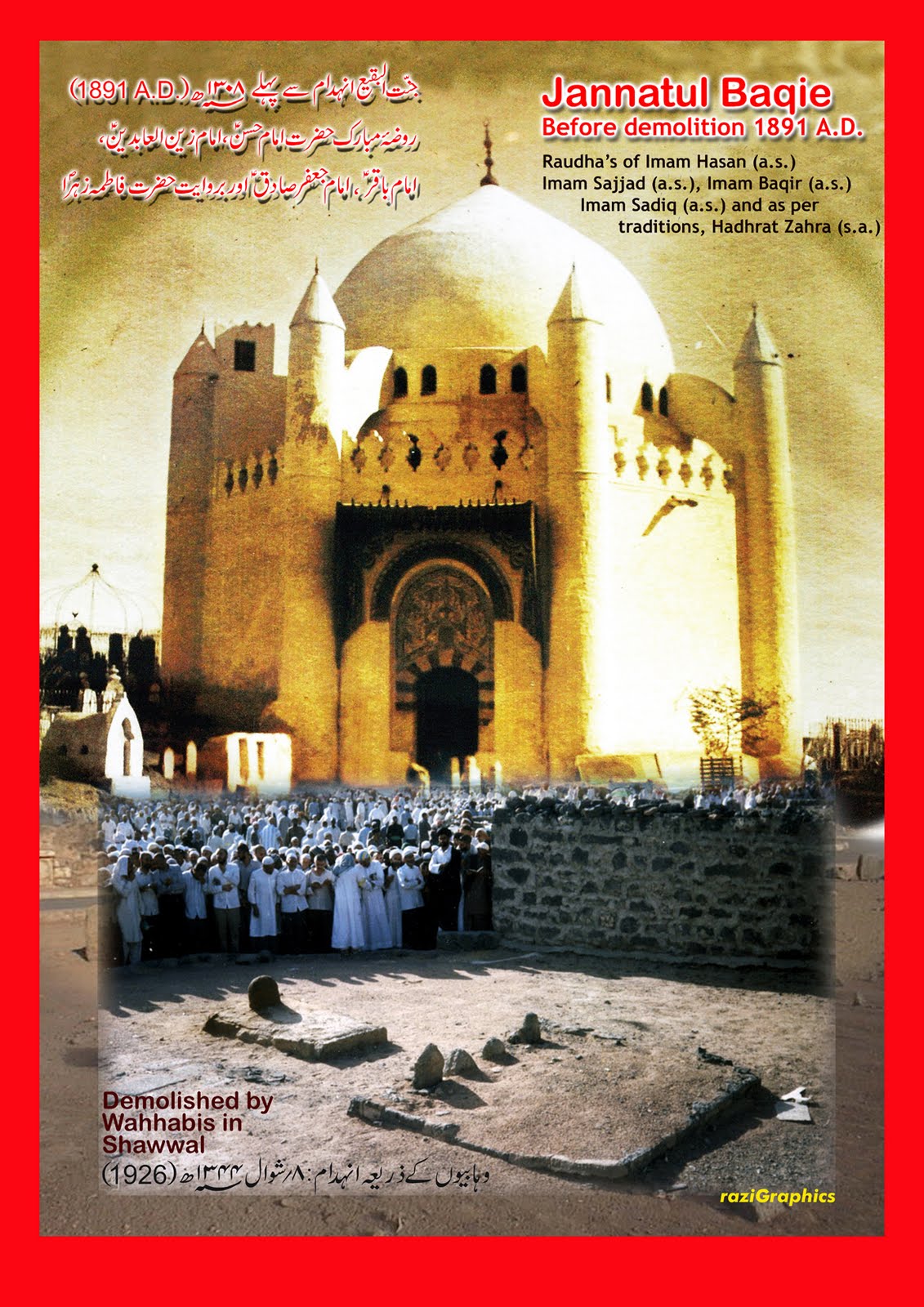
Destruction of Jannatul Baqi - The oppression on Janabe fatima (sa) continues till today

ON THE SAD OCCASION OF THE DESTRUCTION OF THE GRAVES OF JANNATUL BAQI BY THE WAHABIS
( 8TH SHAWWAL -1345 AH / April 21, 1925)


HISTORY OF THE CEMETERY OF JANNAT AL-BAQI

WHERE IMAM HASAN B. ALI (2ND IMAM), IMAM ALI B. AL-HUSAYN (4TH IMAM), IMAM MUHAMMAD B. ALI (5TH IMAM), & IMAM JA'FAR B. MUHAMMAD (6TH IMAM), PEACE BE UPON THEM, ARE BURIED


On 8th Shawwal, Wednesday, in the year 1345 AH (April 21, 1925), mausoleums in Jannatul al-Baqi (Madina) were demolished by King Ibn Saud.

In the same year (1925), he also demolished the tombs of holy personages at Jannat al-Mualla (Makkah) where the Holy Prophet (s)'s mother, wife, grandfather and other ancestors are buried.

Destruction of sacred sites in Hijaz by the Saudi Wahhabis continues even today. According to some scholars what is happening in Hijaz is actually a conspiracy plotted by the Jews against Islam, under the guise of Tawheed. The idea is to eradicate the Islamic legacy and heritage and to systematically remove all its vestiges so that in the days to come, Muslims will have no affiliation with their religious history.


The Origins of Al-Baqi

Literally "al-Baqi" means a tree garden. It is also known as "Jannat al-Baqi" due to its sanctity, since in it are buried many of our Prophet's relatives and companions.
The first companion buried in al-Baqi was Uthman b. Madhoon who died on the 3rd of Sha'ban in the 3rd year of Hijrah. The Prophet (s) ordered certain trees to be felled, and in its midst, he buried his dear companion, placing two stones over the grave.
On the following years, the Prophet's son Ibrahim, who died in infancy and over whom the Prophet (s) wept bitterly, was also buried there. The people of Madina then began to use that site for the burial of their own dead, because the Prophet (s) used to greet those who were buried in al-Baqi by saying, "Peace be upon you, O abode of the faithful! God willing, we should soon join you. O' Allah, forgive the fellows of al-Baqi".
The site of the burial ground at al-Baqi was gradually extended. Nearly seven thousand companions of the Holy Prophet (s) were buried there, not to mention those of the Ahlul Bayt (a). Imam Hasan b. Ali (a), Imam Ali b. al-Husayn (a), Imam Muhammad al-Baqir (a), and Imam Ja'far al-Sadiq (a) were all buried there.
Among other relatives of the Prophet (s) who were buried at al-Baqi are: his aunts Safiya and Aatika, and his aunt Fatima bint al-Asad, the mother of Imam Ali (a). The third caliph Uthman was buried outside al-Baqi, but with later extensions, his grave was included in the area. In later years, great Muslim scholars like Malik bin Anas and many others, were buried there too. Thus, did al-Baqi become a well-known place of great historic significance to all Muslims.

Al-Baqi as viewed by historians

Umar bin Jubair describes al-Baqi as he saw it during his travel to Madina, saying "Al-Baqi is situated to the east of Madina. You enter it through the gate known as the gate of al-Baqi. As you enter, the first grave you see on your left is that of Safiya, the Prophet's aunt, and further still is the grave of Malik bin Anas, the Imam of Madina. On his grave is raised a small dome. In front of it is the grave of Ibrahim son of our Prophet (s) with a white dome over it, and next to it on the right is the grave of Abdul-Rahman son of Umar bin al-Khattab, popularly known as Abu Shahma, whose father had kept punishing him till death overtook him. Facing it are the graves of Aqeel bin Abi Talib and Abdullah bin Ja'far al-Tayyar. There, facing those graves is a small shrine containing the graves of the Prophet's wives, following by a shrine of Abbas bin Abdul Muttalib.
The grave of Hasan bin Ali (a), situated near the gate to it's right hand, has an elevated dome over it. His head lies at the feet of Abbas bin Abdul Muttalib, and both graves are raised high above the ground, their walls are panelled with yellow plates and studded with beautiful star-shaped nails. This is how the grave of Ibrahim, son of the Prophet (s) has also been adorned. Behind the shrine of Abbas there is the house attributed to Fatima, daughter of our Prophet (s), known as "Bayt al-Ahzaan" (the house of grief) because it is the house she used to frequent in order to mourn the death of her father, the chosen one, peace be upon him. At the farthest end of al-Baqi is the grave of the caliph Uthman, with a small dome over it, and there, next to it, is the grave of Fatima bint Asad, mother of Ali b. Abi Talib (a)"
After a century and a half, the famous traveller Ibn Batuta came to describe al-Baqi in a way which does not in any way differ from the description given by Ibn Jubair. He adds saying, "At al-Baqi are the graves of numerous Muhajirin and Ansar and many companions of the Prophet (s), except that most of their names are unknown."
Thus, over the centuries, al-Baqi remained a sacred site with renovations being carried out as and when needed till the Wahhabis rose to power in the early nineteenth century. The latter desecrated the tombs and demonstrated disrespect to the martyrs and the companions of the Prophet (s) buried there. Muslims who disagreed with them were branded as "infidels" and were subsequently killed.

Fadak: Was Abu Bakr merely implementing the will of Rasulullah (sawa)?


The author of ‘The Issue of Fedek: A rebuttal to common lies propagated against Ahl al-Sunnah regarding Ahlul-Bayt’ makes this curious unfounded claim in his article, namely that Abu Bakr used the land in exactly the same manner that Rasulullah (s) wished.
 Ahmad Jawdat Pasha al-Lofji writes in his Qisas-e-Ambiya:
“Rasulullah Sallallahu alayhi wa Sallam devoted his date orchard named Fadak in Khaybar to the pious foundation and dictated how it was to be utilized. He advised in his will that income from the orchard should be given to foreign ambassadors, to visitors, guests and travellers. Hadhrat Abu Bakr, Radhi Allahu ‘Anhu implemented this will during his Khaleefat”.
Reply One
The author’s assertion that Khayber and Fadak were used for supporting guests, travellers and ambassadors is a complete lie. Let us see how Fadak and Khayber was utilised by Rasulullah.We read in Sahih Muslim, Bab ul Fai Book 019, Number 4347:
It has been narrated on the authority of Umar, who said: The properties abandoned by Banu Nadir were the ones which Allah bestowed upon His Apostle for which no expedition was undertaken either with cavalry or camelry. These properties were particularly meant for the Holy Prophet (may peace be upon him). He would meet the annual expenditure of his family from the income thereof, and would spend what remained for purchasing horses and weapons as preparation for Jihad.
Umar said that the land was given to support his family and for weapons, al Lofji claims that it was to meet the expenditure of foreign ambassadors, visitors, guests and travellers.Now the reader has to decide whose words are to be relied upon Umar or those of al Lofji?